Essay · autonomous weapons
AI for Autonomous Warfare Systems
The AI guiding autonomous weapons to their targets is smaller, older, and cheaper, and it does far less computing than the model that drafts your email.
While LLMs are still all the rage, another class of AI is employed to fight wars.
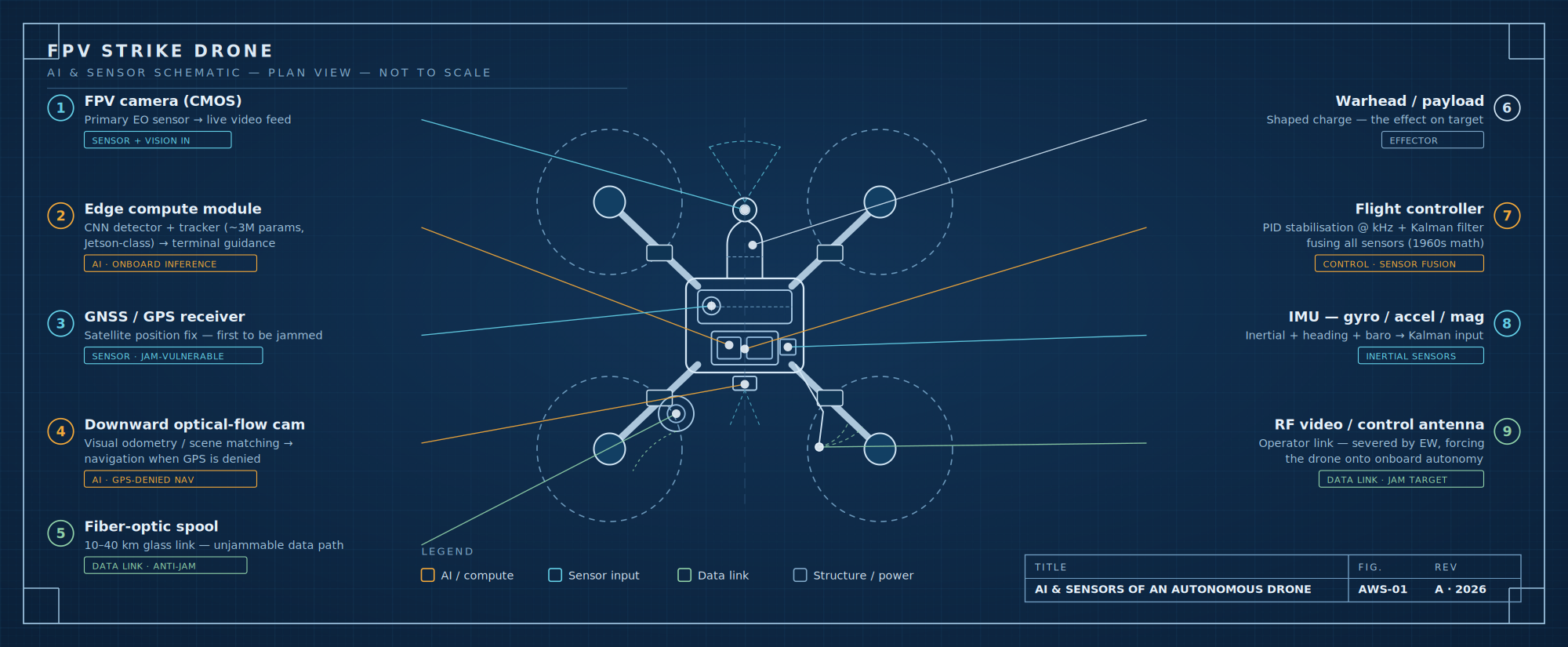
The AI inside autonomous weapons is nothing like a language model. Most of it is small, fast, and boring by LLM standards — a few-megabyte vision model on a credit-card-sized board, closer to a Roomba's brain than to ChatGPT.
It is a layered stack: 1960s estimation theory (the Kalman filter), century-old control loops (PID), 1980s–90s classical robotics (A*, finite state machines, behaviour trees), 2010s computer vision (small CNN object detectors of the YOLO family), and only at the experimental frontier, reinforcement learning.
The model that writes your email is a very large brain reading a very small amount of text. The model that flies into the tank is a very small brain processing a comparatively huge amount of data (mostly video). They are built for opposite problems, and they look nothing alike.
It could be quite surprising how much smaller and older this is than the models we argue about in public.
| Frontier LLM | AI on an autonomous munition | |
|---|---|---|
| Model type | Transformer, generative, general-purpose | CNN detector + tracker + filters, narrow |
| Parameters | ~10¹¹–10¹² (est.) | ~3×10⁶ (≈100,000× smaller) |
| Weights on disk | 100s of GB – ~1 TB | ~6 MB |
| Primary input | ~thousands of text tokens (KB) | ~1 GB of raw pixels in 30 s (a firehose) |
| Compute / task | ~10¹⁴–10¹⁷ FLOP | ~10¹² FLOP for the whole kill |
| Hardware | 8+ data-center GPUs, ~10 kW | one ~$250, ~12 W edge board |
| Latency budget | seconds acceptable | milliseconds, hard real-time |
| Connectivity | always online | must work fully offline (jammed) |
| Trained on | most of the public internet | a few days of drone footage, retrainable in a weekend |
| Training cost | ~10²⁵–10²⁶ FLOP, GW-hours, $100M+ | a few GPU-days; retrainable in a weekend |
| What it optimizes | plausibility of next token | probability the box is the target |
| Where it lives in war | planning, intel, C2 (above the weapon) | the terminal-guidance loop (in the weapon) |
| Failure mode | hallucination, verbosity | misclassification, brittle to novelty |
To be fair, the large multimodal and language models have genuinely entered warfare, but in the cognitive layer above the weapon: intelligence fusion, target nomination, planning, wargaming.
At Palantir's user conference in March 2026, the company showed language models, Anthropic's Claude among them, sorting imagery to surface candidate targets, suggesting which weapon to pair with which target, even drafting the legal justification, collapsing work that used to take thousands of analysts (WinBuzzer, 2026). The Pentagon's Thunderforge programme, begun in 2025, builds language-model tools for planning and wargaming (Breaking Defence, 2025).
How little it costs to think
The comparison becomes concrete with well-understood numbers. Writing one email with a frontier model costs, very roughly, a few hundred trillion arithmetic operations and about a third of a watt-hour of electricity. The energy figure is based on Google's report that the median query to its Gemini model costs 0.24 watt-hours, and independent estimates put a ChatGPT query near 0.3 (DCD, 2025; Epoch AI, 2025). A task where the model loops over its own work, like building a slide deck, costs many times more.
The drone's vision model, which runs for the last thirty seconds of a mission at thirty frames per second on a twelve-watt board, performs approximately eight trillion operations and consumes about a tenth of a watt-hour for the entire task. Guiding a drone into the tank requires about twenty-five times less computing power than writing an email, not to mention the energy needed for the slide deck.
On the drone, the energy requirements for intelligence are marginal. The battery holds around 180 watt-hours; the warhead releases something like 1.2 kilowatt-hours of chemical energy. The "brain" requires well under a tenth of a percent of the energy the mission spends. For scale, a five-second AI-generated video clip is about a kilowatt-hour, roughly the energy of the explosion the drone delivers. Making a clip of a strike costs about as much as an actual strike.
| Metric | LLM writes an email | LLM builds a slide deck (agentic) | Drone kills a tank (terminal guidance) |
|---|---|---|---|
| Model parameters | ~10¹¹–10¹² (est., undisclosed) | same | ~3×10⁶ (YOLO-nano-class detector) |
| Model weights on disk | 100s of GB – ~1 TB (est.) | same | ~6 MB |
| Tokens / data in | ~1,000 tokens (~5 KB text) | 10⁵–10⁶+ tokens over many tool calls | ~1.1 GB raw pixels (30 s × 30 fps @ 640px) |
| Neural compute | ~10¹⁴–10¹⁵ FLOP | ~10¹⁶–10¹⁷ FLOP | ~8×10¹² FLOP |
| Inference energy | ~0.3 Wh | ~5–50 Wh (rough) | ~0.1 Wh (30 s × ~12 W board) |
| Hardware | 8+ H100-class GPUs, ~10 kW server in a data center | same | one ~$250, ~12 W Jetson-class board |
| Total mission energy | — | — | ~150–180 Wh battery + ~1.2 kWh warhead (1 kg TNT eq.) |
Another notable difference is the training. Teaching a frontier model costs tens of millions of dollars and gigawatt-hours of power. Retraining the drone's vision model on last week's footage takes a few GPU-days - an overnight job in an apartment.
What is hard to see
The public argument about dangerous AI is almost entirely about large models, their reasoning, their alignment, and whether they might one day act on their own. Meanwhile, the AI already choosing where to place an explosive is small, cheap, and old, and it draws less attention precisely because it doesn't look like what we've decided to fear. The alarming thing on the battlefield is not a superintelligence. It is a six-megabyte file trained to spot a tank, running on a chip you could buy for a robotics class.
Arms control has always rested on being able to look at a weapon and count it. Autonomy cannot be counted. It is a property of software, and it can change with an update pushed overnight. The same airframe can be remotely piloted in the morning and autonomous by evening, with nothing on the outside having moved.
Norbert Wiener saw it in 1960 ("Some Moral and Technical Consequences of Automation," Science 1960). Building the machine was never the hard part. The hard part is making sure the purpose we put in is the one we want, and now, being able to tell from the outside what purpose is in there.
Appendix A: The autonomy stack
The AI in an autonomous weapon is a layered stack, with each layer having its own model class. This diagram shows the perceive → decide → act loop and where each method sits.
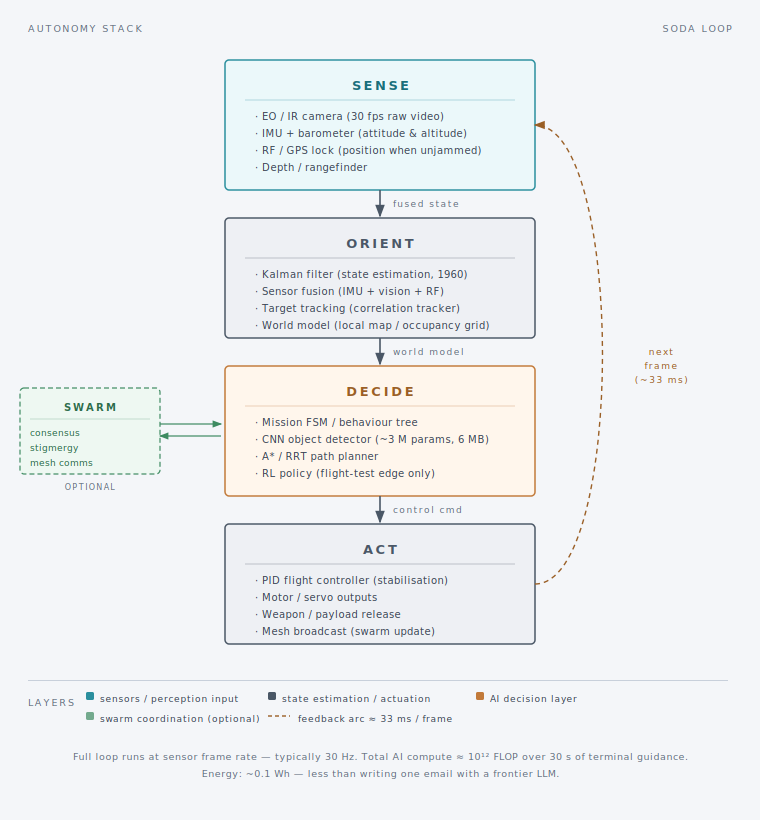
| Layer | Method / model class | What it does | Typical size / cost | Origin | Maturity |
|---|---|---|---|---|---|
| Perception | CNN object detectors (YOLO-family, SSD) | Find & classify targets in a frame | ~3–30M params, ~9–90 GFLOP/frame | AlexNet 2012 → YOLO 2015 | [FIELDED] |
| Perception | Correlation / re-ID trackers | Lock onto a target box, follow it to impact | tiny; runs on MCU-class chips | classical CV, 1980s–2000s | [FIELDED] |
| Perception | ATR (radar/SAR) | Recognize targets in radar returns | template & statistical classifiers, now CNNs | Cold War, MSTAR dataset 1990s | [FIELDED] |
| Perception | Open-vocabulary VLMs | Describe/recognize arbitrary objects, no fixed class list | billions of params; 2.5–16 s/image | CLIP 2021 → 2024–25 research | [DEMO] lab only |
| Estimation | Kalman / extended / particle filters | Fuse noisy sensors into a position/velocity estimate | trivial compute | Kalman 1960, Apollo | [FIELDED] |
| Navigation | Visual odometry / SLAM, scene matching | Navigate without GPS by looking | modest; runs on edge GPU | robotics 2000s; TERCOM lineage 1970s | [FIELDED] |
| Planning | A*, RRT, model-predictive control | Route around threats/obstacles | classical algorithms | A* 1968 (SRI Shakey); RRT 1998 | [FIELDED] |
| Mission logic | Behavior trees, finite state machines | Sequence takeoff→search→engage→return | rule-based, inspectable | control theory / game AI | [FIELDED] |
| Guidance | Proportional navigation, PID | Steer to intercept | closed-form math | 1940s–50s missiles | [FIELDED] |
| Control | Reinforcement learning policies | Learned dogfighting, agile flight, evasion | millions of params, trained in sim | TD-learning 1988; deep RL 2015 | [DEMO] flight-test |
| Swarm | Consensus, stigmergy, auction/market task allocation | Coordinate many agents with no leader | distributed, lightweight | boids 1987; ant-colony 1990s | [FIELDED] at small scale (3–8) |
| Training | World / simulation models (e.g. Nvidia Cosmos) | Generate synthetic data, close sim-to-real gap | large, off-board | generative models 2020s | [DEMO]/commercial |
| C2 (off-weapon) | LLMs / agents | Intel fusion, target nomination, planning, wargaming | 10¹¹–10¹² params, data-center | Transformers 2017 | [FIELDED] in decision-support |
The sources worth actually reading
Books / long works. Paul Scharre, Army of None (2018) — still the standard map; his Four Battlegrounds (2023) for the US–China frame. David Hoffman, The Dead Hand (2009). P.W. Singer, Wired for War (2009).
Reports. CSIS — Ukraine's AI-enabled autonomous warfare (the single best current-state document). OSW — Game of drones. RUSI — Silicon Lifeline. CNAS — AI and Arms Control.
Journalism. IEEE Spectrum — Ukraine's killer drones (June 2025) — the best single tech piece; much of §4B in narrative form. +972 — Lavender. The War Zone — terminal attack autonomy in FPVs.
Primary/historical. Wiener, "Some Moral and Technical Consequences of Automation," Science 1960. Parnas, "Software Aspects of Strategic Defense Systems," CACM 1985. Galison on Wiener's predictor — Cabinet. Swift — Nature 2023. NASA on the Kalman filter's first application.